A story before a service list
A single FDA cybersecurity deficiency letter changed how I build companies.
A few years into running my first cybersecurity company, a founder called me on a Tuesday afternoon. He had spent four years and roughly seven million dollars building a connected infusion pump. The 510(k) was in. Sales was hiring. The board was celebrating.
Then FDA sent a cybersecurity deficiency letter. Twenty-two findings. No threat model on file, an SBOM that was really a spreadsheet, penetration testing done once by a general IT firm that had never touched a medical device. His clearance date evaporated. Payroll had six weeks of runway.
I flew out the next morning. What I saw on his whiteboard was not a security problem. It was a sequencing problem. Every consultant he had hired treated cybersecurity as a checkbox at the end. FDA treats it as an assumption at the beginning. Nobody had told him the difference.
That week I understood the gap that would eventually become Blue Goat Cyber. Medical device teams did not need another generalist pen tester or a compliance PDF. They needed one accountable partner who owned the entire cybersecurity path from threat model to postmarket monitoring, priced up front, and stood behind the outcome.
We rebuilt his submission in eleven weeks. FDA cleared it. He is still shipping. The methodology from that engagement is the methodology below.
What Blue Goat delivers
One accountable partner across the entire device lifecycle.
37+ services grouped into four programs. Engage one piece or the full package.
FDA submissions & secure design
-
Full-Service FDA Premarket Cybersecurity
We own 100% of SPDF, SBOMs, threat modeling, pen testing, and eSTAR documentation for 510(k), De Novo, and PMA.
Explore ↗ -
Medical Device Threat Modeling
FDA-aligned threat models that identify risks early and speed approvals. STRIDE, attack trees, and clinical risk linkage.
Explore ↗ -
FDA Deficiency Response
Got an FDA hold or AI letter? We close cybersecurity deficiencies fast with senior engineers and ready-to-submit responses.
Explore ↗ -
AI/ML Medical Device Security
Defend AI/ML SaMD against adversarial attacks and meet FDA's PCCP, GMLP, and 2025 AI-enabled device guidance.
Explore ↗
Find what attackers will find, first
-
Medical Device Penetration Testing
FDA-compliant device, firmware, app, and cloud testing. Black, gray, and white box across the full attack surface.
Explore ↗ -
BLE, Wi-Fi & RF Testing
Wireless interface testing for BLE, Wi-Fi, Zigbee, NFC, and proprietary RF on connected devices.
Explore ↗ -
Web, API & Mobile App Pen Testing
Front-end, back-end, REST and GraphQL APIs, plus iOS and Android coverage in one engagement.
Explore ↗
Clear procurement, hospital security, and EU launch
-
MedTech Compliance Bundle
One program covering FDA Clearance, SOC 2, HIPAA, HITRUST, and GDPR, run in parallel for hospital-ready and EU-ready launch.
Explore ↗ -
SOC 2 Type II for MedTech
Readiness, control build, and audit support so HDO procurement stops blocking your contracts.
Explore ↗ -
EU CRA for Medical Devices
Cyber Resilience Act readiness: essential cybersecurity requirements, vulnerability handling, and CE-mark conformity before December 11, 2027.
Explore ↗
Stay cleared, stay safe, after launch
-
FDA Postmarket Cybersecurity
Continuous compliance, monitoring, and vulnerability response aligned to FDA Section 524B postmarket plans.
Explore ↗ -
GoatWatch: SBOM Monitoring & VEX
Daily CVE matching, device-context triage, and VEX-ready evidence aligned to FDA Section 524B, without the noise.
Explore ↗ -
Legacy Device Protection
Reduce risk on fielded devices, no redesign, no new submission, no downtime.
Explore ↗
See the full catalogue of 37+ services on the Blue Goat Cyber site.
Browse all services ↗Core offerings, told as scenes
Four programs. Four moments when a founder finally saw the gap.
Every offering below started as a real call from a real MedTech team. The scene is the diagnosis. The supporting content is what we built in response.
The 510(k) that came back with 22 cybersecurity findings.
A Series B infusion pump team had two weeks of runway before their launch window closed. Their consultant had produced a 40-page cybersecurity document that FDA rejected as insufficient. The founder read the deficiency letter to me over the phone, then stopped halfway through and said, "I do not know what half of this means."
The document was a compliance artifact. It was not a security case. FDA does not want a report. FDA wants a defensible story that starts with threats, links to controls, and closes with evidence.
Cybersecurity is not the paperwork you file at the end. It is the argument the whole submission rests on.
What we built in response
- Full SPDF ownership: threat model, security risk assessment, and architecture views tied to clinical risk.
- SBOM generated from your actual build, plus a VEX file FDA reviewers can parse in one pass.
- Penetration testing scoped to your device, wireless stack, mobile app, and cloud endpoints.
- eSTAR-ready cybersecurity package for 510(k), De Novo, or PMA with a 100% clearance guarantee.
The pen test that missed the actual attack surface.
A cardiac monitoring startup shipped us the report from their previous vendor. Twelve pages. Three findings. All low severity. The device had a BLE stack, a companion iOS app, a cloud sync layer, and a firmware update path over the air. The report had only tested the web dashboard.
When we ran the real engagement we found an unauthenticated firmware endpoint that would accept any signed image, including one signed with a leaked developer key from a public GitHub repo. That single finding would have failed the FDA review outright.
A generalist pen test on a medical device gives you a false sense of coverage. Devices need testers who understand the wireless, firmware, and clinical context.
What we built in response
- Black, gray, and white box testing across device firmware, mobile, web, API, and cloud in one engagement.
- BLE, Wi-Fi, Zigbee, NFC, and proprietary RF interface testing with lab-grade tools.
- Findings mapped to FDA guidance, MITRE ATT&CK for medical devices, and your risk file.
- Retest included so remediation evidence lands in the same report package you file with FDA.
The hospital procurement questionnaire that killed the deal.
A newly cleared diagnostic company had a signed letter of intent from a top-ten health system. Then the health system's InfoSec team sent a 380-question vendor security questionnaire with a two-week deadline. The founder called me the day the response was due. They had answered 60 questions.
The questionnaire was really four frameworks stacked on top of each other: SOC 2, HIPAA, HITRUST, and a bespoke set of health-system controls. Without the underlying evidence, no honest answer existed.
FDA clearance opens the door. Hospital procurement decides whether you walk through it. The two happen in parallel, or they do not happen at all.
What we built in response
- SOC 2 Type II readiness, control build, and audit support with a fixed-fee timeline.
- HIPAA and HITRUST alignment mapped to the same control set so evidence is reused, not rebuilt.
- GDPR and EU CRA readiness for teams launching in Europe before the December 11, 2027 deadline.
- Vendor questionnaire response library so the next 380-question form takes days, not weeks.
The 3 a.m. CVE alert that was not actually a problem.
A postmarket team was drowning in vulnerability alerts from a generic SBOM scanner. Every week brought 400 new CVEs. Their engineers spent Fridays triaging noise instead of shipping. When a real critical hit their MQTT broker library, it sat in the queue for eleven days because it looked like the other 399 alerts.
The problem was not detection. The problem was context. A CVE against a library your device does not compile in, or against a code path clinical users never reach, is not the same event as one that touches patient data over Bluetooth.
Postmarket cybersecurity is a signal problem before it is a patching problem. Kill the noise and the real work becomes obvious.
What we built in response
- GoatWatch daily CVE matching against your live SBOM, with device-context triage that suppresses inapplicable findings.
- VEX-ready evidence for every accepted or rejected CVE, aligned to FDA Section 524B postmarket plans.
- Coordinated disclosure workflow and PSIRT support when a researcher shows up in your inbox.
- Legacy device protection for fielded units where redesign and resubmission are not on the table.
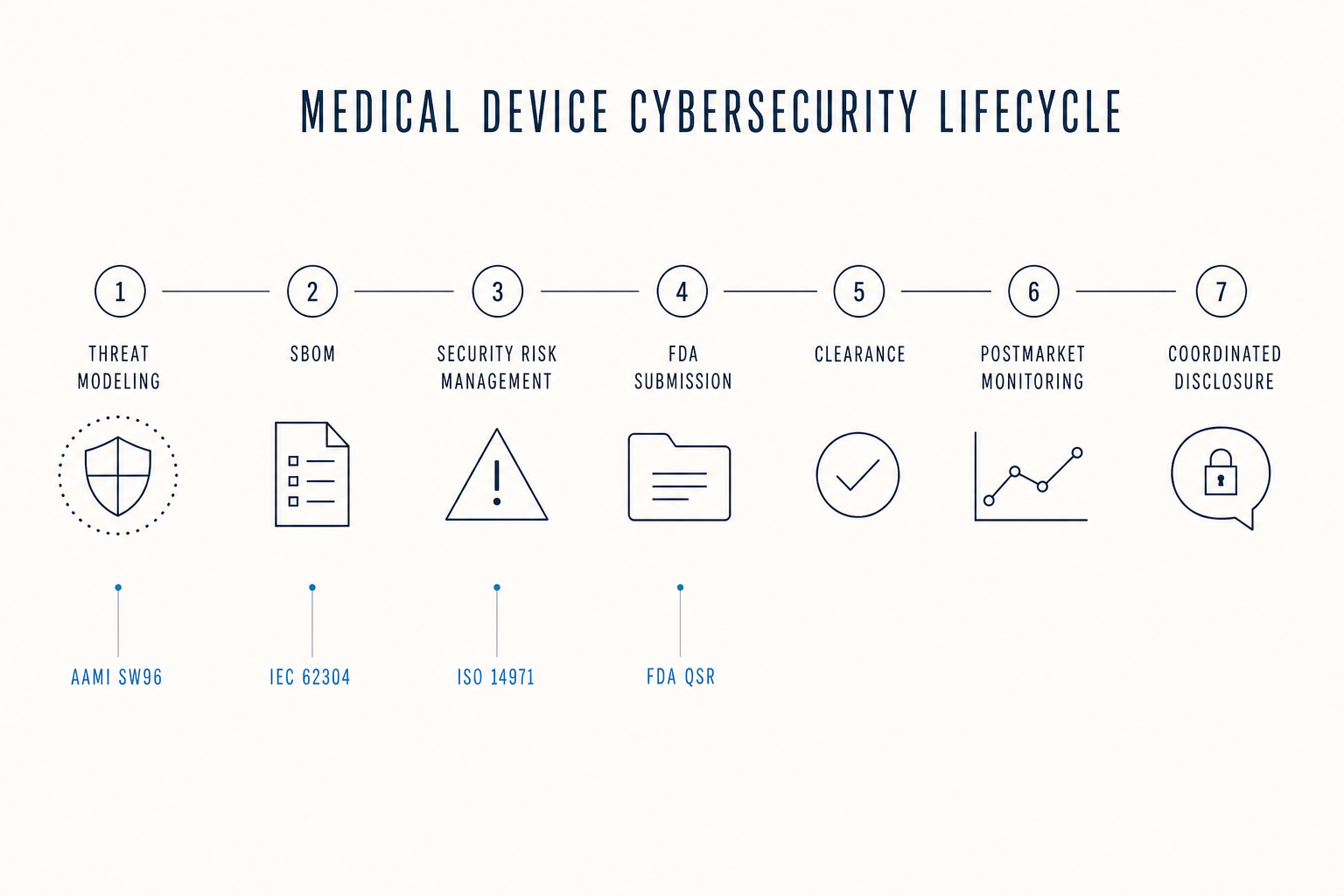
The lifecycle
Premarket through postmarket, mapped.
Track record
250+ FDA submissions. Zero cybersecurity rejections.
Blue Goat Cyber backs every submission with a 100% FDA clearance guarantee: if FDA raises cybersecurity deficiencies, the team resolves them at no additional cost.
- 250+
- FDA submissions supported
- 2–4 wk
- To submission-ready
- 0
- Cyber-driven rejections
- 100%
- Clearance guarantee
- FDA 2026 Guidance
- AAMI SW96
- ISO 13485
- ISO 14971
- Penetration Testing
- SBOMs
- Threat Modeling
Get in touch
Talk to the team at Blue Goat Cyber.
Email info@bluegoatcyber.com or call +1 (844) 939-4628. Response within one business day. Service-disabled veteran-owned. Clients across North America, Europe, the Middle East, and Asia-Pacific.